Experience Designer | IA, Governance & Content Systems

Applying design thinking to a style guide
Imagine joining a team that's operating like it's the early 2000s. That was my impression when I joined the Canadian Red Cross. There were style guides in PDFs from various years, everything hard to find in SharePoint, and honestly no way to tell which one was actually the current one.
It had to be more than an updated guide
I joined as Senior Content Specialist in March 2026, and my mandate was to help build content governance so the team could get aligned. But an up-to-date guide wasn't really the goal on its own. If I built something that only I could maintain, or that was too complicated for the team to actually use, I'd just be adding another outdated PDF to the pile in a couple of years. It had to be usable, scalable, something that could hold up.
Borrowing a UX process for a job that never had one
Even though UX isn't a formalized practice on this team, I built this the way I'd approach any UX problem: exploration, discovery, validation. Here's the roadmap I put together.

Why does a style guide need a roadmap? Because there's a whole team involved, content specialists, architects, a manager, and everyone needs to know what to expect from this. Where they're involved, what the scope actually is, how much time I need from them. It also does something quieter, which is establish that this is mine to own.
Cleaning out the closet first
This part is basically cleaning out a closet. The content already exists, it's just scattered everywhere, so the first job is going through it. What's recent, what's outdated, what's a duplicate of something else, and what's just missing entirely. If there are any open questions, we resolve them through our bi-weekly content discussions.
Content audit spreadsheet:


Team discussion: when to use blocks or italics?
Skipping the card sort, letting the data pick the categories
Sorting through 629 rows across 13 source guides wasn't something I could've done by hand in a matter of weeks, so I leaned on AI to help move through it. I was careful about accuracy though, I prompted it to cite the original source for every row so I could go back and cross-reference rather than just trusting the output.

With the content sorted, next came figuring out the IA. In the past I would've run a card sort, but there was a lot to sort through, the categories were already showing themselves from the audit, and a card sort would've been a lot of team time for something the data was already telling me. So I skipped straight to a tree test instead.
The process looked like this:
-
Generate candidate categories with AI's help
-
Build a questionnaire in Excel to test them
-
Have the team fill it out
-
Aggregate and analyze the results (Optimal Sort was the obvious tool here, but budget wasn't there for it, and I realized AI could do this part too with fairly low risk)
-
Discuss the results with the team and refine

A trial run before committing to anything
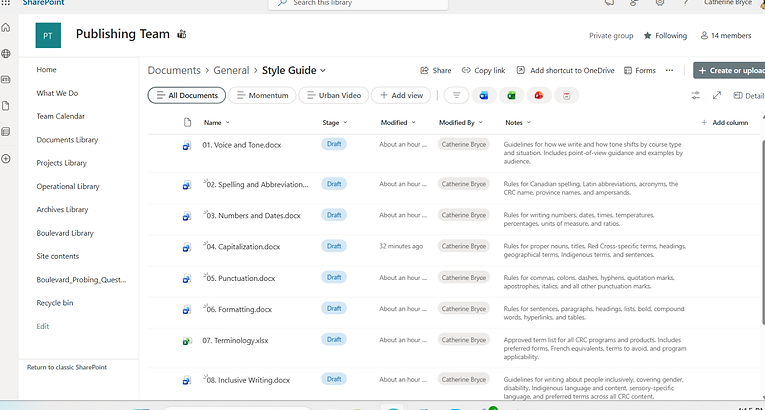
With AI's help and the content for each category refined, I put everything into separate files in SharePoint first. A soft test run, before committing to wherever this was actually going to live long term.
Why Confluence, and not just out of habit
At BMO I'd used Confluence for knowledge sharing and it worked well, so my manager and I were both a little biased toward it going in. But it wasn't just bias. The digital team was already there, which meant this guide could actually connect to the wider CRC ecosystem instead of sitting in its own silo the way everything in Publishing currently does. And honestly, the style guide felt like a good low-stakes pilot for a bigger question, whether Confluence could solve the file management and editing headaches that came with SharePoint more broadly.

How people are finding it (so far, it's on fire)
When I checked in with the team for a temperature check, I got a fire emoji back. That reaction came from the same person who'd originally pushed back and thought Confluence was overkill for this. Now she's genuinely engaged, commenting directly in the docs with suggestions for how to iterate and refine.
Another teammate said something similar in passing too, crediting the guide as a useful reference during a module review, unprompted, in front of the rest of the team. That one landed more than any planned feedback session could have, since nobody asks you to go check a style guide, wanting to is the whole test.


The numbers back it up too, and this is the part I want to actually show rather than just say. For a small team checking a reference doc, a handful of unique viewers returning to each section over and over is the real signal.
373 +
Total views in 3 weeks
3-6
Unique views per page
4
Months to build (while getting other work done)
The real lesson: bring people in before you need them to agree
Get people involved early, and set the expectation up front. The buy-in came from letting people watch it work and giving them a way to shape it as it went.